
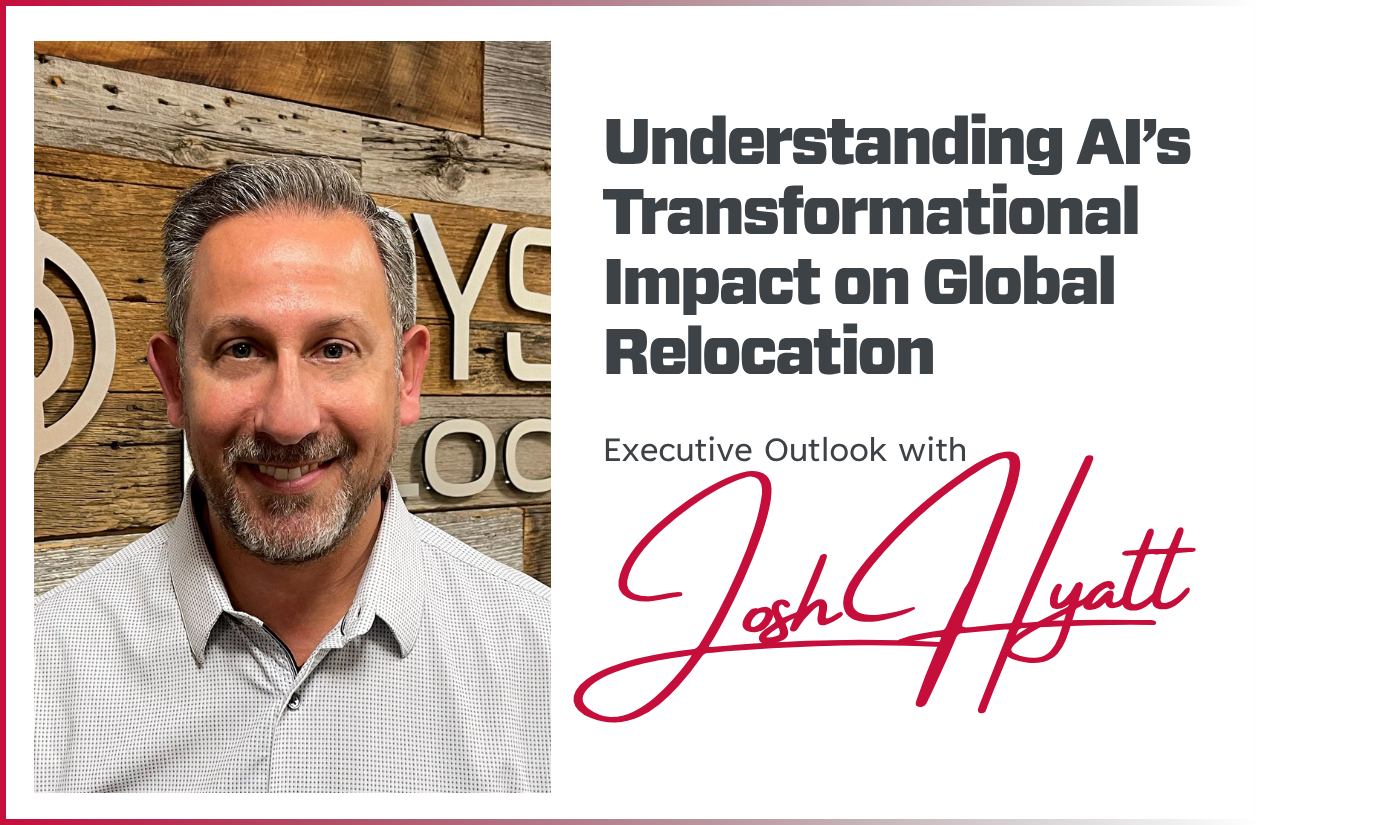
When I started in the relocation industry over 20 years ago, smartphones didn’t exist, most people were not using the internet on a daily basis, and our Relocation Consultants still kept physical files that they locked up each day for security. Just 4 years ago, I had a speech to about 500 at one of our industry’s largest conferences, BAMM. I had ChatGPT write that speech. It wasn’t a great speech and didn’t really sound much like how I talked or had given other speeches. After I told the audience I had ChatGPT write my speech, I surveyed the audience on how many people had heard of ChatGPT. About 10-15 people in a room of 500 had.
The very next year, I gave another speech at the same conference where I had a conversation with an AI version of myself that also spoke fluent Japanese (thanks to AI) and asked the audience the same question about how many people had heard of ChatGPT AND also used it. I couldn’t see a hand that wasn’t raised.
Now fast-forward to today, where Artificial Intelligence is rapidly reshaping the global relocation landscape—moving the industry from a reactive, coordination-heavy model to one that is predictive, data-driven, and increasingly employee-centric. For mobility leaders, this shift is no longer a theoretical, “what if AI could do this or that”. It is real, being actively deployed and is redefining how programs are managed, how costs are controlled, and how employees experience relocation.
At a macro level, AI is driving three fundamental changes across global mobility:
1. From Reactive to Predictive Program Management
AI enables real-time visibility across relocation workflows, identifying risks before they materialize. Instead of responding to delays, mobility teams can proactively manage timelines, suppliers, and employee expectations.
2. From Manual Processing to Intelligent Automation
Historically, relocation has relied heavily on manual coordination—expense audits, document handling, and case tracking. AI is eliminating much of this administrative burden, allowing human expertise to focus on higher-value advisory and employee support.
3. From Static Policies to Dynamic, Data-Driven Decisions
AI-powered analytics and scenario modeling are enabling more accurate cost forecasting, better policy compliance, and smarter vendor selection—resulting in stronger financial governance and improved program outcomes.
How Odyssey Is Applying AI in Relocation
To meet these evolving demands, Odyssey has developed a suite of Insight™ Integrated AI Agents designed to enhance—not replace—the human element of relocation. These tools are embedded directly into the relocation lifecycle, supporting consultants with real-time intelligence while maintaining a “human-in-the-loop” service model.
Some key agents we have built include:
- Relocation Tracker Agent: Real-time milestone tracking and early delay detection to keep moves on schedule
- Expense Intelligence & Anomaly Detection: Automated auditing to ensure compliance and surface out-of-policy spend early
- Dynamic Reporting Using AI Chat: You can use real, normal language to request a report from our system and iterate on the report in seconds. This eliminates the need for understanding often difficult Ad Hoc reporting.
- Destination Insights & Cultural Agent: Personalized, AI-curated content to enhance the employee experience
- Case Summarizer & Note Automation: Consolidated, structured case visibility for faster decision-making
Measurable Impact: What AI Is Delivering
The integration of AI into relocation operations is already producing significant, quantifiable results:
Operational Efficiency Gains
- 19% faster identification and resolution of potential delays
- 81% reduction in manual effort across expense auditing and document handling
- 24% quicker coordination across suppliers and stakeholders
Cost Optimization & Financial Control
- 90% detection rate of out-of-policy expenses, improving reimbursement accuracy
- 52% faster and more accurate reporting
- 28% reduction in escalations and exceptions
- 88% decrease in billing discrepancies and financial escalations
The Long-Term Outlook: AI and the Future of Mobility
I don’t know if I will be giving another speech in front of a large audience on AI and what I might say yet, but looking ahead, if I had to guess, AI’s role in global mobility will continue to expand from operational support to strategic enablement. Over the long term, we expect relocation programs to evolve into fully integrated, intelligence-driven ecosystems that connect talent strategy, workforce planning, and employee experience in real time.
Several shifts are likely to define the next phase of mobility:
- Hyper-Personalized Relocation Experiences: AI will enable fully tailored relocation journeys, dynamically adapting benefits, services, and support based on employee preferences, role requirements, and family needs, moving beyond static policy tiers to more flexible, individualized programs.
- Autonomous Program Management (with Human Oversight): Many administrative and coordination tasks will become increasingly automated, with AI managing workflows, vendors, and compliance in the background, while human consultants focus on advisory, exception management, and high-touch employee support.
- Deeper Integration Across HR and Business Systems: Mobility will no longer operate in isolation. AI will connect relocation data with HRIS platforms, recruiting systems, and financial planning tools, creating a more seamless and data-rich decision-making environment.
- Real-Time Financial and Compliance Governance: Continuous monitoring of costs, policy adherence, and regulatory requirements will become the norm, reducing risk while increasing transparency and control.
Final Thought
The future of global relocation is not AI versus people, it is AI empowering people. Organizations that embrace this model are not only driving efficiency and cost control but also delivering a more seamless, supportive relocation experience for their employees.